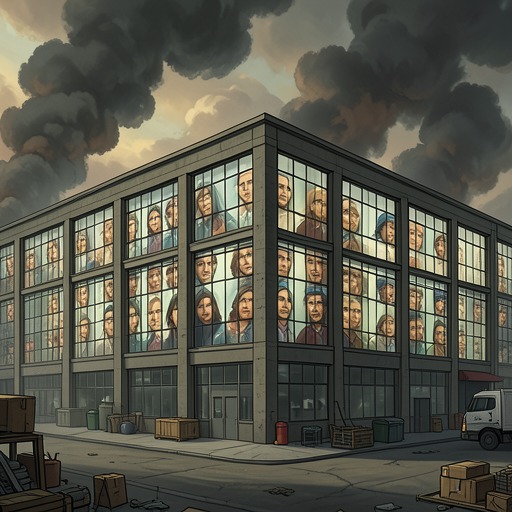
World Controller Committee
Brave New WorldThe World Controllers' Council is the governing body at the summit of the World State, where population, production, pleasure, and knowledge are managed in the name of stability. Its authority reaches from the precise allocation of embryos to the limits imposed on science; its distinctive power lies not only in directing society, but in shaping the desires and assumptions through which people accept direction.
Administration and Population Planning
The Council’s governing logic is visible in the machinery of social predestination. In the Central London Hatchery and Conditioning Centre, labels transfer heredity, fertilization date, and Bokanovsky Group membership from test tube to bottle, turning each developing individual into an identified entry in a system of allocation. The Social Predestination Room contains eighty-eight cubic metres of card-index, updated each morning and coordinated each afternoon. Its records support calculations of how many individuals of each quality are required and establish the optimum decanting rate; anticipated shortfalls are promptly replaced.
The administration is a linked process rather than a single command. Predestinators send figures to the Fertilizers, who provide the requested embryos; bottles are then predestined in detail before being sent to the Embryo Store. This chain makes reproductive production answer to projected social demand. The Council’s power is therefore exercised through specialized work, records, forecasts, and coordinated supply: people are planned as members of a population before they enter society.
Conditioning and the Manufacture of Consent
Administrative allocation is reinforced by lessons designed to make hierarchy feel natural. Children hear that Alphas wear grey and are clever, while Gammas wear green, Deltas khaki, and Epsilons black; the lesson teaches a Beta child to feel satisfied with a place above some castes and below another. The hierarchy is not merely announced as policy. Repeated voices attach evaluations to clothing, intelligence, work, and social rank until caste distinctions become familiar judgments.
The Director describes the process as the gradual incorporation of suggestions into the mind: they adhere like drops of sealing wax, accumulating until they become the material from which a child’s mind—and later the adult’s judgments, desires, and decisions—is made. He identifies the suggestions as the State’s own. A related hypnopaedic proverb, “every one belongs to every one else,” converts a social rule against exclusiveness into an apparently self-evident truth; students accept it after more than sixty-two thousand repetitions in the dark. Governance thus works through habits of thought as well as formal administration: the subject learns to experience prescribed conduct as common sense.
The same process cultivates wants that support the economic order. Children are taught to love flying and new clothes, while the repeated lesson “Ending is better than mending” makes discarding old clothes sound preferable to repairing them. These preferences join consumption to social discipline: the citizen is encouraged to desire practices that sustain demand, rather than needing to be ordered into each purchase. The Council’s reach into ordinary pleasure and judgment helps make political control appear as personal inclination.
Stability as the Governing Principle
Mustapha Mond states the Council’s underlying priority in blunt terms: “No civilization without social stability. No social stability without individual stability.” He presents the social order as a set of wheels that must keep turning, with stable, contented people required to tend them. The image makes continuity the test against which individual freedom and institutional change are judged; anything that threatens the turning system becomes a political danger.
That priority shapes the distribution of work and leisure. Lower-caste workers perform seven and a half hours of mild, unexhausting labour, followed by a soma ration, games, unrestricted copulation, and feelies. Mond says the work suits them, and points to an earlier four-hour-day experiment in Ireland: increased leisure brought unrest and greater soma consumption, not greater happiness. He further argues that labour-saving inventions are withheld because excessive leisure would be harmful to workers. Food could be synthesized, but a third of the population is kept on the land because agricultural production takes longer than factory production. In each case, material capacity is subordinated to the social effects the Council expects a change to produce.
The same reasoning restrains innovation. Mond calls every change a menace to stability and describes pure science as potentially subversive. Even though inventions might increase efficiency, they are not adopted simply because they are possible; their social consequences matter more than technical gains. Science, in this account, is not outside political administration but one of its objects: research is limited so that knowledge cannot undo the equilibrium it helped create.
The Council and the Control of Knowledge
Mond’s account of the Council’s authority is personal as well as institutional. He explains that he was offered a choice between exile to an island, where he could continue pure science, and a place on the Controllers’ Council with the prospect of eventually becoming a Controller. He chose the Council and relinquished science. He says that he sometimes regrets the loss, and distinguishes the demands of truth from the demands of other people’s happiness: the latter, he suggests, is the harder master when it has not been accepted unquestioningly.
His decision exposes the cost behind the language of public welfare. Mond says he likes science and is interested in truth, yet treats both as threats when they challenge the system’s stability. Research is consequently restricted to immediate problems, while other inquiries are discouraged. He traces this policy to the Nine Years’ War: unrestricted science continued even when truth, beauty, and knowledge were treated as supreme goods, but the war’s anthrax bombs changed the political calculation. People became willing to have even their appetites controlled in exchange for a quiet life, and scientific control continued thereafter. Stability is presented not as an eternal condition, but as a political settlement born from catastrophe and maintained by limits on what can be known.
The Council’s defining contradiction is that it relies on science to produce an exceptionally stable society while preventing science from developing freely. Mond credits science with the equilibrium the World State enjoys, but insists that its scope must be carefully limited so it cannot undo its own work. His membership makes that contradiction vivid: the former scientific investigator serves the institution that curtailed the path he might have followed. The Council preserves happiness as a public arrangement, but its terms include the suppression of inquiry and the subordination of truth to managed social contentment.